I've moved to a new site: mwgerard.com
But don't worry -- this site will remain open and all of these posts and comments are on the new site too.
All of my writings and posts, including film reviews, will be housed at the new site.
Please stop by!

29 February 2012
19 July 2011
Thoughts on Harry Potter and the Deathly Hallows, Part 2
I am not a Potter nerd. I've read the books, and I saw most of the movies. They're fine. Fun for the most part. But I'd never stand in line for one, or join a uberfan club in order to get my own Quidditch stick. So I hope fans and non-fans alike will take this list in the manner in which I intend it -- good fun and with a bit of humor. Or humour, if you prefer.
Things I Noticed Upon Viewing the Final Installment of Harry Potter
- Harry, it's time to get some laser eye surgery. (Or as my husband suggested, get someone to do a little occulum repairum or something).
 |
| Is that Hogwarts? Nope, it's Coventry Cathedral after the bombing. |
- Yep, I got it. Potter World = Blitz-era London and England. (see: rubble strew ruins; dour-looking nurses in makeshift field hospitals; Neville as the anti-Neville Chamberlain; sending the kids off to the country; Potter as Churchill post-Coventry; everything begins and ends in a rail station). Please lift the obviousum spell.
- Voldemort seriously needs some lotion.
- Potter and Voldemort are NOT Sherlock and Moriarty at Reichenbach Falls. Stop it.

- Maybe someone should get the students to help hold off the evil army, rather than run up and down lots of stairs.
- Seriously guys. Spit it out! You don't have time to be dramatic, speak in riddles or dance around the issue.
- The Room of Requirement would be a fantastic yard sale.
- A new hairstyle doesn't make you look 19 years older.
- Snape, you've got helmet hair. Someone had to tell you.
- Maggie Smith rules, no matter what.

24 June 2011
REVIEW: GLORIOUS 39

Glorious indeed. This is a wholly original, impeccable new film from writer/director Stephen Poliakoff. A stunning cast illuminates a finite moment in English history -- the summer of 1939, on the eve of the unthinkable.
The story centers on the Keyes family, and is told from the point of view of the eldest daughter, Anne (played by the incomparable Romola Garai). The Keyes patriarch is a well-respected Minister of Parliament and of minor aristocracy. Anne and her brother and sister throw their beloved father (Bill Nighy) a birthday party, which devolves into a political debate that rankles the family.
 |
| Jeremy Northam speaks his mind, however unpopular his opinion |
Intelligent, strong and curious, Anne begins to question England position of Appeasement and the wisdom of Neville Chamberlain. A busy, popular film actress, she has to return to set, but cannot shake the suspicious things she begins to notice. Then, when friends begin dying under mysterious circumstances, she starts to fear the worst. Glorious 39 explores perception versus reality and how it affects day to day life.
I desperately do not want to give away too much. I knew very little when I saw it and its deliberate unfolding is intense. While it features historical figures and issues, it is at its heart an incredibly suspenseful movie. The viewer learns things as our heroine does, and thus we are just as much in the dark. And just as wonderfully, Anne's character is anything but useless. She is smart, spunky, and vigorous. Garai absolutely nails this character and her performance should be lauded. This is the second time that Nighy has played her father and their pairing is so special. I'd be hard-pressed at this point to believe anyone claiming to be Garai's actual father.
 |
| Nighy and Garai - a father daughter moment. |
Suspense, intrigue, mystery, fantastic writing, beautiful photography and lovely performances all converge here. Look also for supporting roles with Julie Christie and Christopher Lee, both legends of the screen as well. It may not be your typical period piece, but it is an amazing piece of filmmaking. Add it to your list.
------
As far as I know, it never enjoyed a theatrical release in the US. It has only just been released on DVD and is available on Netflix.
31 January 2011
FILM: SAVANNAH
Savannah-based film director and writer Annette Haywood-Carter begins shooting in February. Casting for the film, "Savannah", was announced today in Variety: http://www.variety.com/article/VR1118031220
 |
| Jim Caviezel |
 |
| Chiwetel Ejiofor |
The movie tells the story of an unusual friendship in early 20th century Savannah. We look forward to seeing this project come together.
24 January 2011
MESRINE: Parts Un et Deux
Part 1 - Killer Instinct
Part 2 - Public Enemy No. 1

I have rarely been so entranced by what is primarily an action movie. So far-reaching is the protagonist's mayhem that it took two full length films to show just pieces of his exploits. There could easily have been a third.
The saga begins in the early 1960s when Jacques Mesrine (Vincent Cassel) struggles with his post in Algeria. He is assigned to rout out revolutionaries in Algiers and punish with no mercy (these scenes harken back to the equally suspenseful Battle of Algiers). Clearly conflicted, he returns home - to live with his parents. His disillusionment is not unlike those returning from World War I, confused by their elders' insistence that war is honorable, as is a quiet home and a respectable job.
Home life doesn't agree with Mesrine, but he finds that bank robbing holds a thrill, and a paycheck, he can't resist. He becomes more embroiled in the criminal underworld and his "legitimate" life begins to crumble. His wife and kids suffer from his short temper and angry outbursts. He is finally apprehended and jailed for a number of years before he manages to escape (the first of many times). The mood slowly morphs from bebop-infused heists (in which Mesrine insists no one is hurt and only the thieving banks suffer) to dark, solemn, psychologically-disturbed crime.

Cassel very expertly draws this enigmatic character. He will wink and give a half smile that elicits a chuckle, then scrunch up his nose in a sneer that is frightful. Though Mesrine has no problem shooting police officers and stealing money, he is also incredibly charming, a stalwart friend and a fantastic cook. He has never gone back on a promise and never hurts an innocent bystander. The gendarmerie have labelled him Public Enemy #1, but the public are not so quick to condemn. He is a modern Robin Hood.
By the second film, Mesrine (that's MAY-reen) is struggling with this public image. At once admired and reviled, he begins to lash out at those who try to quell his ideas. He attempts to develop his stance as a revolutionary -- fighting against inhumane treatment in prison (like those he suffered), in addition to bringing attention to unfair banking practices and those who control them.

Yet he can never quite reconcile himself with the absolute ruthlessness needed to achieve widespread change. He has a tender side, which he often has trouble dealing with. It's as if two halves are constantly battling one another -- and it's devastating, yet incredible, to watch. We too, as the audience, are at the same time intrigued and repulsed by the outlaw. Perhaps the only thing that is clear is that the ineffectual Paris police force (portrayed as little better than a team of Inspector Clouseaus) caused an unfair end to Mesrine.

The Mesrine Saga is a taut and exciting portrait of a man who really existed. It is a fun crime thriller to be sure, but it also explores what is means to "exist" and the idea that exterior perception can affect interior reality.
_____________________
Many thanks to Psychotronic Films for screening these movies, and to Muse Arts Warehouse for hosting.
View trailers of the films here.
21 December 2010
Rebecca deWinter
Rebecca DeWinter just won't stay dead.

Read about her, and more, in the BACK FROM THE DEAD issue of the Revolving Floor:
http://revolvingfloor.com/issues/6/from-the-diary-of-mrs-dewinter/

Read about her, and more, in the BACK FROM THE DEAD issue of the Revolving Floor:
http://revolvingfloor.com/issues/6/from-the-diary-of-mrs-dewinter/
19 December 2010
REVIEW: RARE EXPORTS

There is plenty to be frightened of this Christmas. At least in Finland. In the world's farthest reaches of desolation, it gets dark by mid afternoon -- and Krampas can come out to play. A father and son manage a meager existence as reindeer ranchers. This year, however, something has affected their normal migration pattern. He and fellow villagers suspect the disturbances on the Korvatunturi mountains may be the culprit, nor are they convinced that the project is only seismic testing when they find explosives and a nearly bottomless pit on top of the mountain.

Piertari (Onni Tommila), the son, is young enough to still believe, and old enough to research the dark folklore, to realize the drilling company is releasing Santa Claus. But this is no "Coca-Cola Santa", he explains. Krampas was an angry old demon who kidnapped and whipped children when they were bad. The Sami people of Finland became tired of this man, so they lured him out on to the ice, where he fell in. As the lake began to thaw, they cut out the block of ice, carried it to the mountains and packed it in several feet of sawdust, to ensure it would never melt and their children would be safe. From then on, only the benevolent Saint Nicolas would bring the festivities of Christmas. When potato sacks, radiators and children start disappearing, Piertari takes charge and must convince the adults he knows how to save the town.
While there are many scary moments, this is not a horror movie. The elves are rather like zombies, the father is a butcher, the bad corporate guy looks just like the short Nazi from Raiders of the Lost Ark, and people are disappearing, but there is no gore. It is suspenseful but not gruesome. That is what makes this film work. It takes itself seriously and doesn't become a silly slasher film. That's not to say it doesn't have it's extremely funny moments.

The child is a great actor with surprising ability. He reminds me of Bruno from the Bicycle Thief. He carries this movie, much as he carries the survival of his town on his shoulders.
Kudos to the Helander brothers, the writers of the film who not only told an engaging story, but included numerous small details that made it possible to believe Krampus might be real.
Adding to the suspense is our own non-understanding of Finnish culture, particularly in their day to day life. The audience's lack of knowledge of what is "normal" makes the simplest things eerie and unsettling.
Adding to the suspense is our own non-understanding of Finnish culture, particularly in their day to day life. The audience's lack of knowledge of what is "normal" makes the simplest things eerie and unsettling.
I let you discover the amazing ending for yourself, but do add this to your annual Christmas movie list.
Official site: http://www.rareexportsmovie.com/en
15 December 2010
Most Underrated Films of the Decade: Part 1
I Capture the Castle (2003)
 |
| Romola Garai stars in I Capture the Castle |
It has all the elements of a fantastic film -- an all-star cast, fabulous production design, a gorgeous score (from Dario Marianelli) and a script based on a book by famed author Dodie Smith (she also wrote 101 Dalmatians). Told from the point of view of the middle child, Cassandra, as she writes in her diary, we see a struggling author and father wrestle his demons and attempt to save his crumbling family. Set in 1930s England, the family lives in a castle ruin that leaks, has draughts and empty cupboards. Yet they manage to scrape by with a forgiving landlord and a fairly productive garden.
The girls fall in and out of love, explore the metropolis, struggle with growing up, and get caught in adventures. Sweet, but not saccharine; funny, but not hilarious; poignant, but not didactic; this adaptation settles and hits a stride nicely. I watch it at least twice a month, if I can. Now available on Netflix Instant. Its R rating is one of the mysteries of the MPAA. It should easily by a PG-13, if not a PG.
The cast includes the brilliant Romola Garai (Atonement, Scoop), the stalwart Bill Nighy, Marc Blucas (of "Angel"), Henry Thomas (E.T., Legends of the Fall), handsome Henry Cavill (The Count of Monte Cristo) and a handful of other faces familiar to watchers of BBC.
A perfect movie for a rainy afternoon. Make a pot of tea and enjoy.
___________________
The Orphanage (2007) / El Orfanato

I was raised on scary movies. I actually wore out the tapes my parents had made of Rear Window, Vertigo and North by Northwest. I remember begging them to not turn the channel when Poltergeist came on. I was four. So it's hard to surprise me (or scare me) with modern movies. They generally have nothing new to say and I've figured out "whodunit" before the opening credits are over. The Orphanage is a refreshing wind that shakes the trees and makes the door creak.
It is the debut outing of Spanish director of Juan Antonio Bayona, heavily supported by producer Guillermo del Toro. Laura (Belen Rueda) purchases the orphanage where she grew up, until being adopted. Married and a mother, she decides to reclaim the crumbling but comforting building and open it once again, this time as a home for children with various disabilities. But when Simon, her son, disappears during the grand opening, she makes every effort to find him - even asking for help from the ghosts of her childhood playmates.
The first time you watch this, you will be frightened and emotionally exhausted. But when you look back on its various moments, you will realize you were only scared because their meaning was unknown. The subtitles are no problem. In fact, the use of the Catalan dialect only enhances the mystery.
Do not watch alone.
___________________
Mrs. Henderson Presents (2005)

Based on a true story, this lively and sweet tale is not to be missed. Mrs. Henderson (Dame Judi Dench) purchases an abandoned London theatre on the eve of WW2. When the English are searching for any sense of levity while under attack from German Luftwaffe raids, The Windmill Theatre puts on spectacular revues -- some of them nude. Faced with begin shut down for indecency, Mrs. Henderson instead creates tableaus where the girls do not move and can therefore be considered stationary art.
 Dench and Bob Hoskins make a charming and winning couple as they attempt to keep the theatre afloat. Christopher Guest is an unlikely but great choice for Lord Cromer, responsible for giving the Crown's approval (or denial) of the theatre's standing. As funny as it is affecting, it is a reminder of the human spirit's determination to make life worth living. Mrs. Henderson herself might have been the inspiration for the unused poster of England.
Enjoy in good health, among friends.
07 November 2010
REVIEW: The Conspirator

Robert Redford is usually an immaculate storyteller but this film was far too caught up in political history lessons to really find an emotional center. The story is an engaging one. Sadly the screenwriter is no better than the writer of the book Manhunt. The research writer managed to make the 12-day chase for Lincoln's assassins a wooden and stilted story. This screenwriter did the same. (Ironically, their names are James Swanson/Solomon). The few scenes with believable dialogue were mostly in the courtroom, which I presume were written primarily from trial transcripts.
James McAvoy, who is generally a very strong actor, underplayed the role. His character is supposed to be a naive, reluctant and novice lawyer, assigned an impossible case, but his moral conviction comes on too late, and far too softly. He would be fiance, played by Alexis Bledel, wears the clothes well, but has no depth whatsoever. If she were truly concerned with, or even confused by the trial, she only acted petulant and shortsighted. No intelligent lawyer would have been with her.

The best performance is delivered by Robin Wright who inhabits the persecuted Mary Surratt, rather than plays her. Accused of treason for her part in harboring the assassins in the Lincoln - Seward attacks, she is made a sympathetic character. Throughout the trial, the audience begins to doubt her complicity in the national tragedy, even if her jury does not. The evidence brought forward certainly brings up some ideas that she may not have known about the plot that was brewing in her own boarding house parlor.
Redford made a misstep in trying to "youthen" the cast with Justin Long and Bledel. They did not blend into the ensemble or seem realistic for the time period. Long gave it a try but he is simply too goofy-looking and Bledel doesn't have the chops to hold her own. Evan Rachel Wood on the other hand gave the most honest performance of the hodgepodge cast. Her quiet stubbornness came from within and she was far more convincing as a defiant but restrained Confederate daughter. Small parts for Tom Wilkinson and Kevin Kline are also not enough carry the weight of others.
 |
| On set, photo by the writer. |
The most relevant theme is certainly the treatment of accused enemies of the state. No one wanted to defend the poor woman. It was assumed she was guilty and to defend her was career suicide. Yet there was a case to be made and she deserved to have a proper defense under the American Constitution. The arguments surrounding the most basic of rights is clearly meant for modern audiences faced with foreign enemies of state.
 |
| On set, photo by the writer. |
As a resident of Savannah, it was fascinating to see the homes and streets I know so well look transformed. And I was excited to watch a scene knowing that I was standing just around the corner, in the shadows as they shouted, "Action." But all of that isn't enough to make the film truly great. Lighting was uneven and relatively poor. Costumes were rather stagy. And the CGI (limited, thankfully) was obvious. It was a rather uninspired attempt to tell and otherwise fascinating tale from American history.
 |
| On set, photo by the writer. |
30 October 2010
REVIEW: BLACK SWAN

Do not bother to see this movie. If you want to know why, read on. If not, I don't blame you. I don't want to revisit it either.
Darren Aronofsky revitalized his career, along with Mickey Rourke's with The Wrestler. This film relies on many of the same themes, mainly an examination of a human's willingness to hurt themselves in order to achieve an ideal. There is no stronger example of this obsession than in ballet. These dancers endure significant pain, bordering on self-mutilation, in order to be the best at what they do. This film also tries to explore the mental anguish and psychological toll such pursuits cause.
 |
| Natalie Portman fears the reflection of her own self |
Sounds good, right?
Additionally, the genre of backstage dramas are (usually) fertile soil for intense relationships, obsessions, hidden motives, and false backgrounds.
Even better.
Sadly, Aronofsky doesn't draw on this. Instead, he resorts to overly obvious symbology and foreshadowing. It seems as though he is trying to channel The Red Shoes, but there is none of the soul or depth of that classic. This is partially the fault of a film that is a jack of all trades. It cannot decide what it is, and therefore never truly achieves, anything. Drama? Horror? Thriller?

Natalie Portman manages to carry the film most of the time, but too be fair, too much is placed on her shoulders. Mila Kunis is her on/off friend, and sometimes foil, who tries to convince her it's ok to relax once in awhile. She too gives a fairly stable performance, but her role is relatively small. The only actor to be completely consistent is Vincent Cassell, as the artistic director of the ballet company. His ruthlessness and passion as a director was multi-layered and well-tempered.
The gasp of surprise that Aronofsky was looking for was not heard. A sigh, perhaps, but no gasp. The only emotional response to be heard is the self-congratulatory applause at the end of the ballet, which he used as the closing credits soundtrack. Tragically, this was a waste of an interesting film idea.
19 June 2010
The Wolfman (2010)
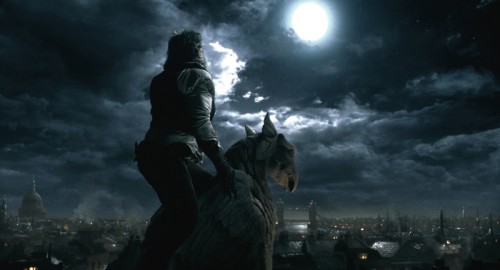 |
| Note a completed Tower Bridge in the background |
Remakes, in general, are a bad idea... and this was a remake of a B-film. Perhaps Universal, the owners of the franchise, were looking for a way to extend their copyright on their classic horror film. The shoot itself seemed to be cursed with uncomfortable costumes, short-tempered actors, alternate endings and multiple rewrites. Of course all of this might point to the extreme efforts by many to actually make a good film out of a cheesy if beloved precursor. Regardless, the result is an uneven product.
This version weaves father-son tension, filial jealousy and uxorcide into the often gory scenes. While these themes are clearly there to "explain" a son's fear and hatred of his father and a penchant for roaming, no one element is ever fully explored. This lack of completeness lands the film on the wrong side of the tracks, I'm afraid. Rather than lend credibility and convince the audience that this film was taken seriously; it merely reveals that it only wanted us to think it was being taken seriously.
Someone in the production team (it's nearly impossible to divine who) actually has a penchant for Victorian-era philosophy and social constructs. The underlying details are quite thoughtful. Colonialism, Orientalism, Freudian scholarship, gothic literature, Darwinism, and the crumbling aristocracy are touched upon. Sadly, none is ever followed through. The biggest miss is most certainly the story of Singh, the father's valet from India. Yet, for all this research and attention to detail there a glaring mistake. The film is supposedly set in 1891, as announced in the opening moments. But, a completed Tower Bridge is spanning the Thames in two specific shots (the bridge was opened in 1894).
Thankfully, the "monster" scenes are few. The fur and makeup were not convincing, or even very frightening. They are gory, but in a drive-in movie sort of way. Anthony Hopkins brings just a smidgen of Hannibal back to the screen and plays his shallow role with as much professionalism as an Oscar-winning role. Benecio del Toro is less satisfying. He is more emo than angsty. Emily Blunt is lovely and superb. I look forward to watching her in years to come. But it is Hugo Weaving as the Scotland Yard inspector who steals every scene. He full embodies every Lestrade, Whicher, and Japp ever played.
The strongest part of the film is the cinematography by Shelly Johnson. Every shot is gorgeous and ethereal. Lowlight, candlelight, moonlight, fog, lantern - you name it, he can shoot it. It is clear that he too has read his Sherlock Holmes and studied his Caspar David Friedrich. Without his rich vision, the film would have been entirely unwatchable. In fact, look for a shot the looks just like this painting by Friedrich.
Someone in the production team (it's nearly impossible to divine who) actually has a penchant for Victorian-era philosophy and social constructs. The underlying details are quite thoughtful. Colonialism, Orientalism, Freudian scholarship, gothic literature, Darwinism, and the crumbling aristocracy are touched upon. Sadly, none is ever followed through. The biggest miss is most certainly the story of Singh, the father's valet from India. Yet, for all this research and attention to detail there a glaring mistake. The film is supposedly set in 1891, as announced in the opening moments. But, a completed Tower Bridge is spanning the Thames in two specific shots (the bridge was opened in 1894).
 |
| Hugo Weaving |
 |
| Lighting and motion captured by Shelly Johnson |
 |
| Two Men Contemplating the Moon by C.D. Friedrich |
11 April 2010
The Dark Corner (1946)

I've truly been enjoying the discovery of Lucille Ball films that pre-date her more famous comedienne years. I stumbled upon an early Douglas Sirk melo-noir called Lured that has somehow slipped through the cracks (my review here). Where that was decidedly dark and broody, The Dark Corner is a classic private detective noir. It isn't the fast-talking slapstick of a Thin Man, it is more fast-paced and light than, say, The Big Sleep. And very well-written.

Private Eye Bradford Galt (Mark Stevens) is being followed by a ghost form his past. When a hooligan turns up dead, the police look to him for answers. When they find no other suspects, their attentions turn to Galt -- but his witty secretary (Ball) takes his side and helps him find the real killer.

Ball plays her character with a combination of sassy yet vulnerable that other famous noir bombshells didn't manage to achieve. Perhaps it was the exacting director, Henry Hathaway, that brought out the best in her, and the rest of the cast, including post-war regular William Bendix. Hathaway (himself underrated) has a list of noir thrillers that stand out above the genre, including 14 Hours and Niagara. This film revels in deep-focus photography (see above) making the entire city and its inhabitants a part of the unfolding mystery. Passersby by are part of the scene, not movement in the background. These extra layers make The Dark Corner gritty, lively and more realistic.
30 March 2010
Alice in Wonderland (3D)

I put off writing this one for a few reasons. In fact, it may be too late to influence anyone, but the irritation I felt still lingers.
Burton did Alice a disservice. There I said it.
I wanted to like it, I really did. I had been excited to see it from the day I heard Time Burton was taking the classic out-of-body tale on. Until the day I saw the first trailer. It looked nothing like what I had expected, but Burton was fresh from Sweeney Todd, which I found brilliant, so I hoped that perhaps it was a just an unfortunate edit. But doing a little non-spoiler research, I learned that the story was completely made-up - a sequel to Alice's first well-known trip. Yet I pressed on, setting aside my usually-vehement protection of literary sources to see if this reimagining could deliver.
It delivered numerous sighs, forehead-to-palm slaps and a headache (not caused by the forehead slapping).
An older Alice (Mia Wasikowska) finds herself being forced into a society marriage with a useless fool and in a fit of fear, she runs off and follows a rabbit (Michael Sheen) down a hole. She meets a string of familiar characters, but doesn't remember that this is her second trip to Wonderland (actually, Underland, we come to find out). The Red Queen (Helena Bonham Carter) is still impetuous and the White Queen (Anne Hathaway) is useless and she needs the help of Alice to restore her to the throne -- and she can't do it without also saving the Mad Hatter (Johnny Depp).
None of these seasoned actors manage to bring anything inventive, though they are not at fault for following Burton's direction. It all starts to feel vaguely like a Narnia story (human girl must save the magical land, talking animals, good and bad royalty, Quixotic yet wise creatures) that we have seen before. With all the characters of Wonderland and Burton's imagination, this should have been something incredible. Sadly, it is as if Tarantino did a fairy-tale in gothic style (not a complement). It is flat, story-less and boring.
Little good stands about the animation and effects either. The Knave (Cripsin Glover) is half-CGI, half-actor and he never looks right. The Red Queen's floating CGI head is too disturbing and distracting to be effective. They use cheap 3D tricks like a Atlantic City amusement park. The opening (and closing) sequences, set in the English countryside, are the only convincing minutes. Here we see what Burton is truly gifted at. His Todd-styling is in full swing and there is a subtlety to the characters that is lost everywhere else.

Only the animation of the Chershire Cat (Stephen Fry) is enjoyable. Whoever was in charge of his creation has a cat - and did their homework. I'm sorry to see this film raking in so much at the box office. Though I can't really blame the ticket-buying public. I was sucked in, and fell down the rabbit hole myself. But all I was left wondering was why they couldn't manage to get this right.
30 December 2009
Sherlock Holmes

I grew up on Sherlock, quite literally. I grabbed my dad's heavy volumes and looked at the original Strand etchings even before I could read the complicated stories. And Jeremy Brett IS Sherlock Holmes. Doyle himself couldn't have a qualm with that casting. So I was initially thrilled when I heard of the pairing of Robert Downey, Jr and Jude Law as the storied sleuths. Then I saw a trailer and felt betrayed. Since when was Sherlock an action hero? And Watson a slimy-looking ingrate? I even get annoyed at the Basil Rathbone films when Watson is portrayed as a bumbling fool. He is an doctor! It was explained to me that this film was being based on graphic novel, not the stories, but I wasn't satisfied. Sherlock is great - why mess with it?
Then post-Christmas ennui set in and as the family sat around eating leftovers for dinner we contemplated our entertainment options (As funny as the word "squeakquel" is, we weren't going to sit through a story about hip-hop rodents). We agreed (amazingly enough) on seeing Sherlock Holmes, all with the understanding that it not be compared to any other adaptations, or even the writings, really. I chose to think of it as a guy in Victorian London who gets involved in sci-fi adventures.
I am not an easy convert, but Sherlock ended up being a fun film and much more literary than I anticipated. The "case" was not taken from any story I am aware of, but had elements of Holmesian problems. Indeed, the consequences for not solving it in time were much more monumental than anything that Sherlock faced, except maybe the Naval Treaty.
It employed an interesting device, that was thankfully not overused, of letting us in on Holmes' thoughts and reasoning before seeing him carry it out. It works, particularly by being introduced in a boxing match, that no Guy Ritchie movie can be without.
Downey, Jr. brings a nice levity to the character, and clearly was inspired by Brett's facial tics and idiosyncrasies. Jude Law does well as Watson, but the character itself doesn't quite find its footing. I don't blame Law, but rather the storyline. It uses him as a soundboard for Holmes, which he often is, but it falters when it tries to give him his own backbone.
The heroine, if she can be called that, is played by Rachel McAdams. She too is passable, has a few scenes in which to shine, but her talent is underutilized. Her character is also the only one that drops the ball in terms of production design. Her frocks are ridiculous and hot pink. Not a good idea. The rest of the set design was superb. 221b is a fabulous mess, one can almost smell the stench of the Thames, and the villain's lairs reek of turn-of-the-century nostalgia (I am fairly certain they used the same prison yard and warehouse in Nolan's The Prestige. And I think Watson wears the same jacket as Branagh's Hamlet).


The face off with the bad guy got a bit long, and the "girl" isn't all that, but overall, the movie was very enjoyable, even for a stalwart Holmes fan. There is plenty to make a fan smile, and enough to keep a general viewer engaged. The clues were dropped is a smart way, something not often seen anymore. They weren't overt and obvious. There is nothing more annoying than knowing the answer to the mystery but having to wait 2 hours for everyone around you to figure it out. Not the case here. Ideas were subtle enough to be mysterious yet visible enough to avoid the cliche it-was-the-guy-you-never-saw-who-did-it-the-whole-time (i.e. Bone Collector).
In short, go see Sherlock Holmes, even if you think you won't like it. It won't be like any Sherlock you've seen before - but it won't be unrecognizable.
28 November 2009
Up in the Air

I truly wish the TV commercial for this movie did not tout it as being the "from director of Juno." That is selling it short. Or worse. Juno was self-conscious in almost every aspect. Up In The Air, however, is anything but that. It is fresh, funny and touching -- and probably marks (I hope) a new epoch in George Clooney's somewhat uneven career (What was Leatherheads, anyway?)
Clooney's character, Ryan Bingham, acts as the narrator for a simple tale of a man who finds contentment in what others would consider drudgery. He spends as much of his time in planes, airports, hotels and rental cars as work will allow. He is precise and committed (as we are shown this through Wright/Pegg-like editing as he packs his suitcase, goes through security, etc.). If he were a hue, he would be a comfortable, unoffending grey. He uses this muted personality to deliver pink slips to employees at companies around the country. It becomes clear that while he doesn't enjoy the job, he knows that he is good at it, or as good as anyone can be, and finds comfort in the idea that he is at least trying to lessen the blow.
Young whippersnapper Natalie Keener (Anna Kendrick) joins the firing firm and announces that the company could save significant funds by laying off employees via teleconference. Horrified at the insincerity of this change, and what it means for his own way of life, he convinces boss Jason Bateman to let him go on one last trip to show Keener the tricks.
Now confronted with a loneliness he has not experienced, and the possibility that he may never meet up again with his airport fling, Alex (Vera Farmiga), he returns to the job with a new intensity.
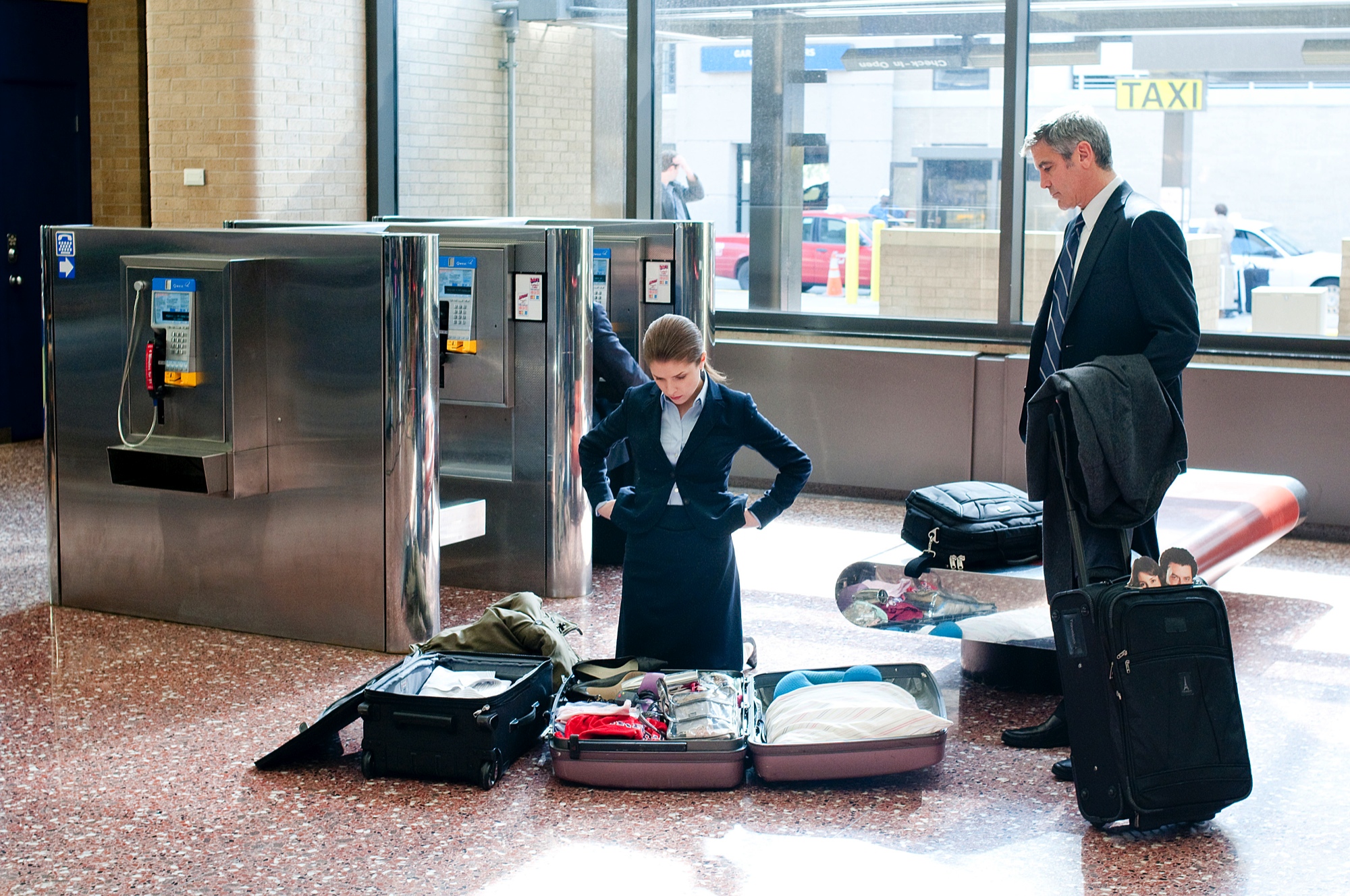
The movie is very witty, sharp, wry and funny. It is also genuine and touching. The punches are not pulled, even if they are somewhat expected. The setups are not so overwhelming obvious that the audience is just waiting for their fulfillment. The ride is actually interesting and enjoyable. Clooney is channeling someone from his father's era with Cary Grant-like goofy expressions (see Charade, 1963), and he is comfortable in it. Kendrick plays an overeager overachiever well. She brings enough naivete to the role to make her vulnerable and therefore sympathetic. Farmiga's range in this role is stunning. She and Clooney have an unmistakable chemistry that is a joy to watch. So much so that when she displays a coolness, it makes the audience squirm. It is convincing and unnerving at once.
Aside from the nauseatingly obvious and repetitive product placement of one of the major airlines, Up In The Air has much to recommend it. Finally, someone decided to just tell a good story. And they made it very enjoyable.
Subscribe to:
Posts (Atom)