Showing posts with label england. Show all posts

24 June 2011

REVIEW: GLORIOUS 39


Glorious indeed.  This is a wholly original, impeccable new film from writer/director Stephen Poliakoff.  A stunning cast illuminates a finite moment in English history -- the summer of 1939, on the eve of the unthinkable.  

The story centers on the Keyes family, and is told from the point of view of the eldest daughter, Anne (played by the incomparable Romola Garai).  The Keyes patriarch is a well-respected Minister of Parliament and of minor aristocracy.  Anne and her brother and sister throw their beloved father (Bill Nighy) a birthday party, which devolves into a political debate that rankles the family.  

Jeremy Northam speaks his mind, however unpopular his opinion
Intelligent, strong and curious, Anne begins to question England position of Appeasement and the wisdom of Neville Chamberlain.   A busy, popular film actress, she has to return to set, but cannot shake the suspicious things she begins to notice.  Then, when friends begin dying under mysterious circumstances, she starts to fear the worst.  Glorious 39 explores perception versus reality and how it affects day to day life. 

I desperately do not want to give away too much.  I knew very little when I saw it and its deliberate unfolding is intense.  While it features historical figures and issues, it is at its heart an incredibly suspenseful movie.  The viewer learns things as our heroine does, and thus we are just as much in the dark.  And just as wonderfully, Anne's character is anything but useless.  She is smart, spunky, and vigorous.  Garai absolutely nails this character and her performance should be lauded.  This is the second time that Nighy has played her father and their pairing is so special.  I'd be hard-pressed at this point to believe anyone claiming to be Garai's actual father.

Nighy and Garai - a father daughter moment.
Suspense, intrigue, mystery, fantastic writing, beautiful photography and lovely performances all converge here.  Look also for supporting roles with Julie Christie and Christopher Lee, both legends of the screen as well.  It may not be your typical period piece, but it is an amazing piece of filmmaking.  Add it to your list. 

------
As far as I know, it never enjoyed a theatrical release in the US.  It has only just been released on DVD and is available on Netflix.  
19 June 2010

The Wolfman (2010)

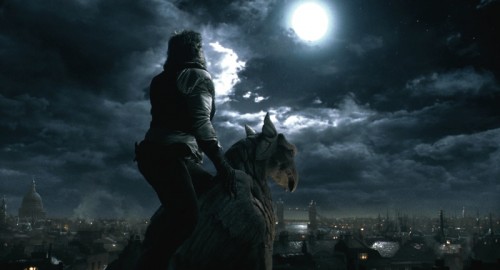
Note a completed Tower Bridge in the background
Remakes, in general, are a bad idea... and this was a remake of a B-film.  Perhaps Universal, the owners of the franchise, were looking for a way to extend their copyright on their classic horror film.  The shoot itself seemed to be cursed with uncomfortable costumes, short-tempered actors, alternate endings and multiple rewrites.  Of course all of this might point to the extreme efforts by many to actually make a good film out of a cheesy if beloved precursor.  Regardless, the result is an uneven product. 

This version weaves father-son tension, filial jealousy and uxorcide into the often gory scenes.  While these themes are clearly there to "explain" a son's fear and hatred of his father and a penchant for roaming, no one element is ever fully explored.  This lack of completeness lands the film on the wrong side of the tracks, I'm afraid.  Rather than lend credibility and convince the audience that this film was taken seriously; it merely reveals that it only wanted us to think it was being taken seriously.

Someone in the production team (it's nearly impossible to divine who) actually has a penchant for Victorian-era philosophy and social constructs.  The underlying details are quite thoughtful.  Colonialism, Orientalism, Freudian scholarship, gothic literature, Darwinism, and the crumbling aristocracy are touched upon.  Sadly, none is ever followed through.  The biggest miss is most certainly the story of Singh, the father's valet from India.  Yet, for all this research and attention to detail there a glaring mistake.  The film is supposedly set in 1891, as announced in the opening moments.  But, a completed Tower Bridge is spanning the Thames in two specific shots (the bridge was opened in 1894).

Hugo Weaving
Thankfully, the "monster" scenes are few.  The fur and makeup were not convincing, or even very frightening.  They are gory, but in a drive-in movie sort of way.  Anthony Hopkins brings just a smidgen of Hannibal back to the screen and plays his shallow role with as much professionalism as an Oscar-winning role.  Benecio del Toro is less satisfying.  He is more emo than angsty.  Emily Blunt is lovely and superb.  I look forward to watching her in years to come.  But it is Hugo Weaving as the Scotland Yard inspector who steals every scene.  He full embodies every Lestrade, Whicher, and Japp ever played.

Lighting and motion captured by Shelly Johnson
The strongest part of the film is the cinematography by Shelly Johnson.  Every shot is gorgeous and ethereal.  Lowlight, candlelight, moonlight, fog, lantern - you name it, he can shoot it.  It is clear that he too has read his Sherlock Holmes and studied his Caspar David Friedrich.  Without his rich vision, the film would have been entirely unwatchable.  In fact, look for a shot the looks just like this painting by Friedrich.
Two Men Contemplating the Moon by C.D. Friedrich

04 November 2009

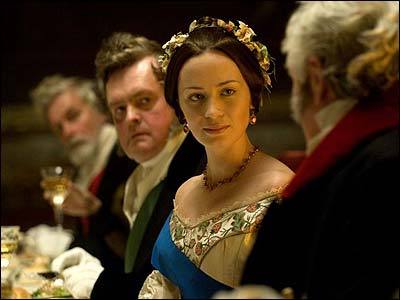
The Young Victoria

The Brits have a love/hate obsession with their royals that is still somewhat a mystery to Americans. We have our celebrities that we love to hate but rarely, if ever, do we follow their story from birth to death. The young princes William and Harry have been speculated about since before they were born. For England, it has been true since the monarchy was installed. And as Americans, we have a limited, cursory view of the woman whose name inspired an era synonymous with propriety and staid relationships.
Seeing Academy Award winning screenwriter Julian Fellowes tender dramatization of Queen Victoria's early years was refreshing, lovely and often amusing. He interpreted a time in her life before she had become comfortable with power. Having been groomed to be nothing but a figurehead, she defied numerous pressures to take her place as the longest reigning English monarch to date.

Emily Blunt (who looks more than a little like HRH) brings an understated, light honesty to the role. She manages to show Victoria's humor, stubbornness, strength, compassion and uncertainty. Rupert Friend takes on the awkward but sweet and sincere Prince Albert of Saxon-Coburg. Their onscreen chemistry enhances the flirtatious nature of their courtship.
Most striking about the film's presentation is how accessible it is. Despite the depictions of excessive wealth, power, inane protocol, the audience is constantly aware that these are just people. It is more than a costume drama. It makes one of history's most notable love affairs as simple as a college sweetheart romance. They are nervous, excited, and have fights, just like any couple. The audience was actually cheering when the two finally become engaged -- even though we all knew the Victoria and Albert were a couple.
Additionally, Jim Broadbent's boisterous King William is very funny, and again underscores that everyone has an ungrateful aunt, a difficult uncle or an annoying cousin. Families will be families, no matter how blue their blood.

The Young Victoria bases itself on true events, including Sir John's vehement wish for a Regency, the attempt on Victoria's life and Victoria and Albert's adjoining desks. Of course, much of the dialogue is speculation, but Fellowes embeds so much that we cannot help but fall in love with the royals, just like any Brit.

09 June 2008

Son of Rambow

This little gem will sit and rot out in the multiplex for a week before being swept aside for the next big blockbuster. But if it came to your town, do go see it.
It's a sweet, nostalgic tale of childhood, imagination and growing up. Set in 1980s Britain (rural, not London) two school boys become unlikely chums. Lee Carter is a clever troublemaker, and Will is quiet and helpful -- and forbidden to watch TV, along with other strictures due to his neo-Puritan upbringing. Quite by accident, Will sees Rambo: First Blood and is completely enchanted with it. Lee, who had already decided to enter something into the BBC's young filmmaker's contest, pairs up with Will and the two make their our version of the action classic, dubbing it Son of Rambow.
The film follows the ups and downs of friendship between the two unlike companions, but more impressively, it views the world from a child's perspective without reducing it to naivete. Both of these characters are dealing with very stressful situations in their family life and do so with admirable maturity. The film also weaves subtle details into the plot which surround a child's imagination. Things mentioned earlier, arrive later, in a more colorful and outrageous form. As it should, it reminds one of their own childhood and the strange things they used to do to amuse themselves.
The only shortfall is about three-quarters of the way into the film when Lee and Will's friendship is on the rocks. There are three contiguous scenes which deal with one apologizing to the other and vice versa. Theses are strung together with nothing in between where we might understand what was being apologized for, or what had transpired to induce the other to seek forgiveness. It does pick itself up and get back on track, however, for a lovely final scene.
Both young men are very good actors and the supporting cast was also very strong. If only there were more films like this, to remind us of ourselves when we had no idea how to be embarrassed or afraid of being thought silly.

02 May 2008

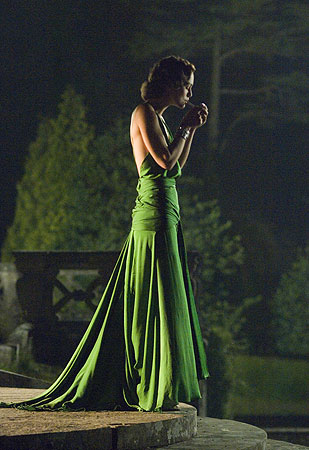
Atonement

ATONEMENT
I admit to being wary of this film. I generally find the "toast of the Oscars" films to be less than satisfactory as a complete package. That buzz coupled with the two headline actors - Keira Knightley and James McAvoy - caused yet more trepidation. And as if that wasn't enough, I was also doubtful of helmer Joe Wright, whose Pride and Prejudice was too fast and held neither of the delightfulness or the gravity of the Austen story.
Wright returns to a period piece, very definitely English, but he chooses the 1930s this time. It evokes the fragile years between the wars as its own character. Those who are to the manor born may have escaped the immediate calamity of shell-shocked, damaged population and the downward spiral of economies across the world but the devil-may-care attitude they still engender does catch up with them. Old houses and sultry summer afternoons in a quiet countryside are not innocent, and neither are their upper crust residents. This slightly Gothic, Daphne du Maurier world is paired with the point of view of a little girl. The opening act seems to use some sort of slip time mechanism that allows the viewer to see these events from alternating angles, and these scenes carry with them the immensity of spirit of each character.
Its main plot point - a precocious but angry Briony at age 13, lies about something of grave magnitude - brings to mind how easily the balance is set off-kilter, how little it takes for the entire direction of life to change.
This fragility, underscored by the delicateness of 1930s England, is expertly conveyed in Atonement.
The performances of all the characters are superb. Knightley's spoiled, privileged character is underpinned with a sympathy not easy to accomplish. McAvoy, too is able to affect the audience with more than a little puppy-dog look so often found in romance movies. This film never stoops to that level. Its power is real. Watch for a lovely but short performance by Romola Garai as Briony age 18. Stunned almost silent by her own guilt she resorts to working as a nurse in bomb-raided London, in an attempt to do penance. The last and oldest iteration of Briony is played by the eternal Vanessa Redgrave. Maybe the finest casting of an aging character I've ever seen. All three displayed incredible depth - and each carried enormous continuity through. (In this final scene, Briony's interviewer is the late Anthony Mingella.)
Also of note is the 5:30 single shot on the shores of Dunkirk. Extraordinarily effective. Gorgeous cinematography and set/costume design all around.
130 minutes. Based on the novel by Ian McEwan. Won Academy Award for Best Score. Nominated for Best Picture, Cinematography, Art Direction, Adapted Screenplay, Costume Design and Supporting Actress.